
Introduction:
Imagine facing quarter-end crunch time with a short-handed accounting team. Talent is hard to find, budgets are tight, and deadlines aren’t budging. For many U.S. CFOs and Controllers, the solution increasingly lies beyond domestic borders. Offshore accounting staffing – essentially hiring accounting professionals abroad as part of your virtual finance team – has moved from a niche idea to a mainstream strategy. In fact, a recent survey found that nearly 90% of financial executives have now outsourced some accounting functions, largely to counter the ongoing accounting talent shortage (unity-connect.com). Another 2024 study of mid-sized companies revealed that 45% of middle-market firms are outsourcing their accounting in whole or in part, a huge jump from just a year prior (cfobrew.com). These trends underscore a new reality: U.S. finance leaders are increasingly exploring cost-effective accounting solutions overseas to fill talent gaps, reduce costs, and keep their finance operations running smoothly. Before you dive in and hire an offshore bookkeeper or accountant, though, it’s important to understand what this approach entails – the benefits, the risks, and the best practices to ensure success.
What Is Offshore Accounting Staffing?
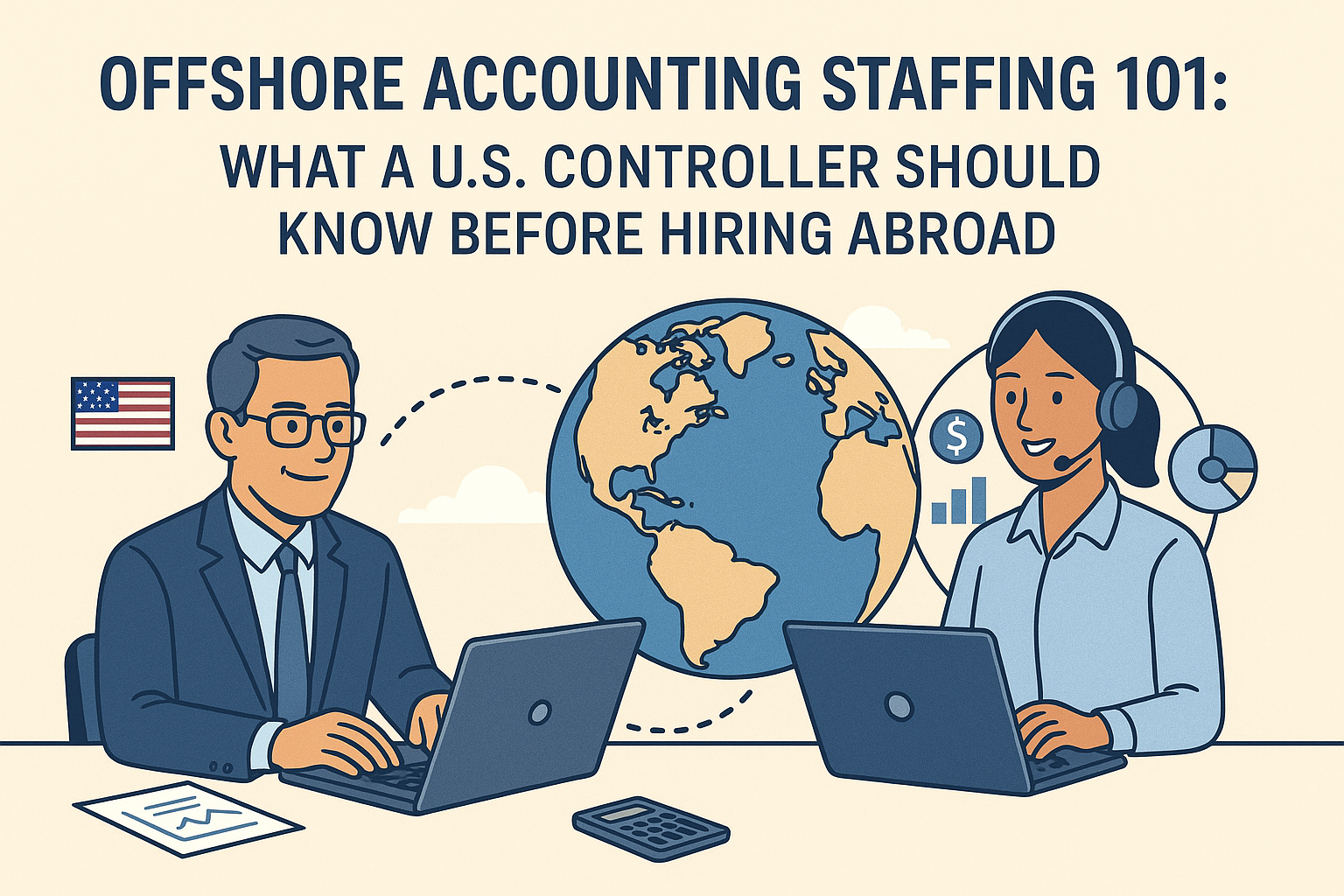
Offshore accounting staffing means hiring accounting and finance professionals located in another country to work for your organization remotely. In practice, this could involve partnering with an outsourcing provider who supplies dedicated offshore accountants to your team, or directly recruiting talent abroad through a subsidiary or third-party service. Either way, these offshore team members function as an extension of your in-house staff – a virtual accounting team working from places like India, the Philippines, Latin America, or other talent-rich regions. They can handle a range of tasks (from outsourced bookkeeping and accounts payable processing to financial reporting or even controllership duties) without sitting in your physical office. Modern cloud software and collaboration tools make it possible for an accountant 8,000 miles away to reconcile accounts or close the books almost as easily as someone in the next cubicle.
This approach is a form of outsourcing focused on accounting roles, but it’s slightly different from handing everything off to an external accounting firm. With offshore staffing, the overseas professionals are typically dedicated to your company’s work and integrate with your processes and culture – you retain oversight of their day-to-day tasks, as if they were your own employees (just remote). Outsourced accounting can also refer to hiring an external firm to fully manage a function (like outsourcing your payroll to a service provider). Offshore staffing often falls somewhere in between: you get the benefit of global talent and cost savings, while still directing the work. Popular destinations for building these offshore teams include countries known for strong finance talent and lower labor costs. For example, nations like India, the Philippines, Mexico, and Malaysia host large pools of English-speaking, skilled accountants and offer favorable business environments (unity-connect.com). The key idea is to tap into global accounting talent – wherever it may be – to support your U.S. finance operations in a flexible, economical way.
Why U.S. Finance Leaders Are Exploring Offshore Talent
Several converging challenges are pushing CFOs and Controllers to consider offshore staffing for accounting and finance roles. The most urgent driver is the well-documented accounting talent shortage in the United States. Hiring and retaining accountants has become extremely difficult – in a 2024 Controllers Council survey, 69% of finance leaders said they struggle to find and keep qualified accounting staff (controllerscouncil.org). The pipeline of new accountants is shrinking (first-time CPA exam candidates plunged by one-third from 2016 to 2021 (unity-connect.com) even as a wave of veteran CPAs nears retirement( unity-connect.com). This crunch has left many companies understaffed and scrambling to cover essential tasks. It’s no surprise that companies are “looking for new ways to support and scale their teams,” as one outsourcing executive noted (unity-connect.com). Offshore staffing presents an appealing way to access talent when local hiring falters.
Cost pressure is another big motivator. U.S. accounting salaries and overhead have risen with the talent shortage and inflation. Controllers tasked with tightening budgets are eyeing offshore accounting as a way to do more with less. Simply put, hiring abroad can dramatically lower your labor costs. According to Deloitte’s Global Outsourcing Survey, offshore providers typically offer 40–60% lower labor costs than equivalent onshore talent (linkedin.com). Some accounting firms report saving as much as 50–70% on staffing expenses by offshoring certain roles (qxaccounting.com). These savings aren’t just hype – they reflect real differences in wage levels and operating costs across countries. For a CFO, that could mean the difference between having two accountants on staff versus four, for the same personnel budget. Offshore staffing can be a strategic way to stretch a lean budget without sacrificing work quality.
Beyond alleviating talent and cost issues, there’s a broader trend of increased comfort with remote work and outsourcing in the finance function. The pandemic forced accounting teams to work virtually, proving that location might be more flexible than previously thought. As a result, stigma around outsourcing has faded. In fact, outsourcing accounting has “exploded in popularity” recently – nearly half of mid-market companies outsourced at least part of their accounting in 2024, whereas a year earlier the vast majority hadn’t even considered it (cfobrew.com). Even public accounting firms have doubled down on outsourcing offerings. Client accounting services (CAS) – essentially outsourced bookkeeping/controller services – was the fastest-growing niche for firms in 2024, with 84% of top accounting firms seeing higher demand for it (cfobrew.com). Clearly, many organizations (including your peers and even your auditors) are embracing the concept that certain finance tasks can be effectively handled off-site.
Importantly, the rationale for offshoring is no longer just about saving a buck – it’s also about staying operational and competitive. Deloitte’s 2023 survey found that 51% of organizations were actively exploring new geographic locations for operations, with access to qualified talent now a key driver alongside cost considerations (offsiteoffice.com). In other words, CFOs are using offshoring as a tool to ensure business continuity for finance processes when domestic talent isn’t available. When you can’t hire a staff accountant locally, plugging into a global talent pool can keep the financial close on track. And for forward-looking finance chiefs, an offshore strategy can also provide scalability (quickly adding resources for a new project or acquisition) and even continuous coverage (think follow-the-sun workflows where your U.S. team hands off work at day’s end to overseas colleagues who then advance the ball overnight).
Benefits of Offshoring Your Accounting Operations
When done right, offshore accounting staffing can yield significant benefits for your finance organization. Here are some of the key advantages U.S. companies see:
- Dramatic Cost Savings: The most touted benefit is cost reduction. Thanks to lower salary levels and operating costs in popular offshoring countries, companies often save on the order of 50% (or more) on labor costs for comparable accounting roles (linkedin.com) (qxaccounting.com). For example, the salary for an experienced accountant in India or the Philippines might be a fraction of the U.S. equivalent. By offloading certain tasks to offshore staff, CFOs can cut overhead while still maintaining or even increasing headcount. These savings extend beyond wages – benefits, office space, and other employee-related costs are also minimized. The bottom line: offshoring can be a highly cost-effective accounting solution, allowing you to reinvest those savings elsewhere (new technology, strategic hires, etc.) or improve your profit margins.
- Access to a Broader Talent Pool: Offshoring opens the door to skilled professionals you might not find at home. There’s a vast global supply of accountants, many with certifications and expertise in U.S. GAAP, IFRS, and international tax rules (qxaccounting.com ). Countries like India churn out many English-speaking accounting graduates every year, including chartered accountants with knowledge of U.S. accounting standards. Similarly, the Philippines has a strong pool of finance and accounting talent servicing U.S. companies. By hiring abroad, you can tap into this global talent pool to find specialized skills (for instance, a consolidation expert or a NetSuite-certified accountant) that are scarce or expensive locally. This not only fills immediate vacancies but can also improve the overall capability of your finance team. You’re no longer limited to who is available in your city or willing to relocate; the virtual finance team model lets you recruit the best talent from anywhere.
- Scalability and Flexibility: Offshore staffing provides flexibility that traditional hiring often can’t match. Need to ramp up headcount for a heavy audit season or a big backlog of reconciliations? Offshore providers can often source additional accountants quickly, letting you scale up without the long lead time of domestic hiring. Conversely, if you need to scale down or adjust roles, it’s typically easier and less costly with outsourced arrangements. Many companies use offshore teams to handle seasonal or cyclical work, expanding and contracting as needed. This flexibility extends to work scheduling as well – with teams in multiple time zones, you can arrange coverage almost 24/7. For example, an offshore accountant can be processing transactions or preparing reports during U.S. overnight hours, enabling a faster turnaround on deliverables (qxaccounting.com). In essence, offshoring adds a layer of agility to your finance function. It’s much easier to handle growth, special projects, or staff departures when you have on-demand access to an extended team.
- Focus on Core Activities: Delegating routine accounting tasks offshore can free up your onshore team to focus on higher-value work. Many controllers start by outsourcing bookkeeping activities – accounts payable, bank reconciliations, expense coding, etc. – which are essential but time-consuming and not strategic. Having offshore staff take over these repetitive processes means your U.S. accountants and finance managers can devote more energy to analysis, decision support, and strategic projects. As one industry guide noted, offloading compliance and bookkeeping tasks to offshore teams allows in-house staff to concentrate on high-value advisory work (qxaccounting.com). Instead of burning hours on data entry or routine journal entries, your team can work on budgeting, financial modeling, or business partnering with other departments. This rebalance can improve job satisfaction for your core team (reducing burnout from grunt work) and increase the overall impact of the finance function.
- Continuous Coverage and Faster Close Cycles: With an offshore component, you can take advantage of time zone differences to improve productivity. For instance, a U.S. controller can hand off tasks at 5 PM to an accountant in Sri Lanka or Mexico who is just starting their workday. By the U.S. morning, those tasks might be completed, effectively shortening turnaround times. Companies have leveraged this for things like accelerated monthly close – while the U.S. team sleeps, the offshore team is crunching numbers. The result can be a smoother, 24-hour workflow that speeds up reporting and meets deadlines more easily (qxaccounting.com). Additionally, if your business operates globally or across U.S. coasts, having team members in different time zones can provide support to regional operations during their business hours.
In short, offshore accounting staffing can deliver a win-win: cost-efficient expansion of your team and operational improvements. You get more hands on deck for the same or lower cost, and often a quicker, round-the-clock work cycle. That said, these benefits depend on managing the offshoring arrangement well. Without the right approach, you might not fully realize these gains – which is why understanding the potential pitfalls (and how to address them) is so important.
Key Concerns and Risks (and How to Mitigate Them)
Despite the advantages, hiring abroad isn’t a silver bullet, and it does come with its share of concerns. As a controller, you might be asking: What could go wrong, and how do I protect my company? Here are some common risks financial leaders cite regarding offshore accounting staffing, along with strategies to mitigate them:
- Communication and Time Zone Challenges: Working across continents can introduce language barriers, cultural differences, and plain old scheduling headaches. Miscommunication or delays can occur when your team is not all in the same room (or country). In fact, companies frequently cite differences in language and work culture as a major challenge in offshoring – one survey found over half of firms saw cultural fit issues as a significant hurdle (linkedin.com). To mitigate this, establish clear communication protocols from day one. Plan overlapping work hours if possible (e.g. an hour or two each day when your U.S. team and offshore team are both online together). Leverage video conferencing and collaboration tools to keep everyone connected “face-to-face” virtually. It also helps to invest in a bit of cross-cultural training for both sides, so U.S. staff and offshore staff understand each other’s work styles and expectations. With intentional communication strategies, many companies find that their virtual teams operate almost as seamlessly as local ones.
- Quality Control and Oversight: Handing over financial tasks to a team across the ocean can feel like a loss of control. How do you ensure the offshore accountant’s work meets your quality standards and complies with U.S. regulations? This concern is very common – you’re essentially trusting critical financial data and processes to someone you can’t physically observe. The key here is to implement robust oversight mechanisms. First, choose a partner or hiring model where you retain visibility: for example, ensure your offshore staff use the same accounting systems as your in-house team so you can review their work in real time. Set clear performance metrics (accuracy rates, timelines, etc.) and monitor them closely at the start. Regularly scheduled check-ins, weekly status updates, and review of outputs will help you catch issues early. It may also be wise to start with less critical tasks in the beginning (e.g. outsource routine bookkeeping before tackling complex financial analysis) as a way to test quality and build trust. Over time, as confidence grows, you can expand their responsibilities. Many companies also mitigate this risk by partnering with reputable providers who have proven track records and internal quality checks. If you’re working with an outsourcing firm, do your due diligence to ensure they screen for qualified professionals and have supervision in place. And of course, document your processes thoroughly – clear SOPs and guidelines will set expectations and make it easier for offshore team members to follow the required procedures exactly.
- Data Security and Confidentiality: Accounting work inevitably involves sensitive financial information – general ledgers, payroll data, customer payment info, maybe even bank accounts and credit cards. One of the biggest fears about offshoring is exposing this sensitive data to external parties or far-away jurisdictions. You’re essentially handing over the keys to the books, which can be unsettling (expertiseaccelerated.com). To address this, security must be a top priority in any offshore arrangement. Mitigation measures include: ensuring the provider has strong data security protocols (encryption, secure networks, up-to-date cybersecurity practices), requiring strict confidentiality agreements and NDAs from offshore staff, and possibly limiting access to only the data needed for their task (principle of least privilege). Many reputable offshore accounting firms are well aware of these concerns and comply with standards like GDPR and SOC 2 for data protection (qxaccounting.com). As a controller, you should also consult with your IT and legal teams about cross-border data considerations – for instance, if your financial data will reside on servers overseas or be accessed from another country, does that pose any compliance issues for your industry? Generally, working with established providers who regularly handle U.S. client data can give you peace of mind. It’s also wise to retain control of critical accounts and approvals internally (e.g. you might let offshore staff prepare payment runs, but a U.S. manager still gives final approval). With strong controls, offshore accounting can be done securely, but it requires vigilance and choosing the right partner.
- Compliance and Regulatory Concerns: Along with data security, you might worry whether an offshore accountant will adhere to U.S. accounting principles, tax laws, and compliance requirements. Finance is a heavily regulated function – mistakes in revenue recognition or tax compliance can be costly. Fortunately, one can mitigate this risk by carefully vetting the qualifications and training of offshore hires. Many offshore accountants are certified and well-versed in U.S. GAAP, IRS rules, and even Sarbanes-Oxley requirements if they’ve worked with U.S. clients (qxaccounting.com). When engaging an offshore firm, ensure they provide staff with the necessary expertise (for example, ask if their team includes CPAs or chartered accountants with relevant experience). You should also provide adequate training on your company’s specific policies and the nuances of your industry. Treat your offshore staff like new hires in terms of onboarding – cover your internal controls, reporting deadlines, and review processes so they understand the compliance framework they must operate in. It can also help to keep critical sign-offs and judgments (like approving financial statements or choosing accounting treatments) in the hands of your U.S. controllers/CFO, while using offshore staff for the groundwork (preparing schedules, reconciliations, initial drafts). In summary: ensure offshore team members are properly qualified and integrate them into your compliance processes, and you can largely mitigate regulatory risks.
- Hidden Costs and Operational Issues: On paper, offshoring promises cost savings – but some finance leaders worry about hidden costs or logistical snags that erode those savings. These could include unexpected transition costs, management overhead, or technology incompatibilities. For example, if an offshore team has unreliable internet or if you need to invest in new software licenses for them, those are additional expenses. There’s also the time investment of your existing team to train and coordinate with the new offshore members. To avoid surprises, it’s important to plan the offshoring transition carefully and choose a partner with good infrastructure. Upfront, get clarity on all fees (recruiting fees, monthly charges, etc.) so you know the true cost. Opt for providers who include things like local HR support, IT equipment, and redundancy plans (for power outages or other disruptions) as part of their service (offsiteoffice.com). Also, set aside some internal time for knowledge transfer – perhaps one of your senior accountants will spend a few hours a week for the first month reviewing the offshore team’s work or answering questions. This is an investment that pays off by preventing errors. In terms of operations, ensure the offshore staff have access to your systems and software through secure remote connections, and test this early. With good planning, you can keep the “hidden” costs low and maintain the expected ROI.
- Geopolitical and Reputational Risks: Finally, consider the broader context – sending work overseas can carry geopolitical risks (like political instability or changes in law in the host country) and potential reputational considerations. While many popular offshoring destinations are stable, unforeseen events can happen. Additionally, some stakeholders may initially react negatively to the idea of jobs being offshored. To mitigate these, do a bit of homework on the country you choose: is the business climate stable? How is the government’s relationship with the U.S.? Also, work with partners who uphold high labor and ethical standards, so you’re not exposed to any scandals (e.g. ensure no child labor, fair working conditions, etc., in your offshore operation). Diversifying can be a strategy too – some companies spread operations across two locations to hedge against disruptions in one. In terms of reputation, transparency can help: internally communicate the rationale (e.g. “we’re augmenting our team to better serve our customers around the clock”) and highlight that your domestic team’s roles remain vital. As offshoring becomes common in finance, stakeholders (investors, board members) are more understanding, especially when it’s framed as a way to enhance capabilities rather than just cut costs.
In summary, the risks of offshore accounting staffing are manageable with due diligence and good management. Thousands of companies have navigated these concerns successfully. The key is to go in with eyes open: acknowledge the challenges, address them proactively, and choose your offshore approach carefully. That leads us to the final part – how exactly to get started and set up an offshoring initiative for success.
Steps to Successfully Hire Offshore Accounting Staff
If you’ve decided to explore offshore accounting staffing, a structured approach will improve your chances of a smooth and rewarding experience. Here is a step-by-step guide for U.S. Controllers and CFOs considering hiring abroad:
- Define Your Needs and Objectives: Start by identifying which accounting functions or roles you want to offshore, and why. Are you trying to fill a specific talent gap (e.g. you can’t find a payroll specialist locally)? Reduce costs on a particular process (like bookkeeping or accounts payable)? Or scale up your team for growth? Be clear on the goals – it will help determine the right model and partner. It’s often wise to begin with non-core or transactional tasks that are well-documented. Routine processes such as bookkeeping, accounts receivable/payable, or basic reconciliations are commonly offshored first (qxaccounting.com). This allows you to test the waters with lower-risk work before considering more complex functions.
- Choose an Offshoring Model: Next, decide the model that fits your needs. Broadly, you have a few options:
- Outsourcing to a Provider: You contract an accounting outsourcing firm (or a specialized offshore staffing company) to provide one or more accountants who work dedicatedly for you. The provider handles recruitment, HR, and often infrastructure; you manage the day-to-day work of the individual(s). This is a popular approach as it’s relatively quick and the provider handles compliance and admin in the offshore country.
- Captive Offshore Team: If you foresee building a larger team and want direct control, you could set up your own offshore office or subsidiary and hire staff directly there. This gives you full control but involves more upfront effort and understanding local labor laws. It’s less common unless you plan to hire dozens of people.
- Freelancers/Contractors: In some cases, companies hire remote freelance accountants from abroad via online platforms. This might work for very limited or project-based needs, but for ongoing staffing a structured provider or captive team is usually preferable for reliability and data security.
- Perform Due Diligence on Providers and Candidates: Before signing anything, thoroughly evaluate your chosen partner (or the candidates if you’re hiring directly). Key considerations include:
- Expertise and Qualifications: Verify that the offshore accountants have the skills you need. Do they have accounting degrees or certifications? Are they familiar with U.S. GAAP or IRS tax code as needed? It’s reasonable to ask for résumés, conduct interviews, or even give a brief skills test. Remember, you’re not just buying a service; you’re effectively hiring team members, so vet them as carefully as you would a domestic hire.
- Data Security Measures: Ask the provider about their IT security and confidentiality protocols. Do they have secure networks, VPN access, and encryption? Have they dealt with sensitive financial data before? Ideally, the firm should comply with standards like SOC 2 or ISO 27001 for data security (qxaccounting.com). Ensure NDAs will be signed and that you retain ownership of all financial data and intellectual property.
- References and Track Record: Request references or case studies from U.S. clients of similar size/industry. A provider who has successfully worked with other U.S. controllers will understand common pain points (closes, audits, etc.). Don’t hesitate to reach out to those references and ask candidly about their experience, any issues, and how they were resolved.
- Infrastructure and Backup Plans: Confirm that the offshore team has a reliable workspace, whether it’s a secure office or approved home setup. Check if they have backup internet/power (especially in countries where outages can happen). The provider should also have contingency plans for disasters or political events so your work isn’t severely disrupted.
- Set Clear Expectations and Processes: Once you’ve chosen your offshore staff (or partner), invest time in onboarding them thoroughly. Communicate clearly what their responsibilities will be, what deliverables and deadlines are expected, and what quality standards must be met. It can be very useful to document your processes (if not already done) – for example, provide a month-end close checklist or a step-by-step procedure for how invoices are approved in your company. Setting up Service Level Agreements (SLAs) or at least agreed turnaround times for key tasks can help align expectations. Make sure the offshore team knows the calendar of your financial cycle (when audits occur, when tax filings are due, etc.). Essentially, treat them as a true member of your team: they should know your organization’s policies (like approval limits, coding conventions) and the context behind their work. The more information you share up front, the faster they’ll become productive. Also establish how work will be reviewed and by whom – for instance, you might require that a U.S. manager reviews all journal entries prepared offshore for the first few months. Clear, documented workflows will go a long way to ensure consistency and accuracy.
- Implement Strong Communication and Integration: One of the most critical success factors is how you integrate your offshore staff into your communication rhythms. Set up a communication plan that might include: daily check-in emails or chats, weekly video meetings for status updates, and shared project management boards for tracking tasks. Regular communication builds trust and keeps everyone on the same page. Encourage your onshore team to treat the offshore colleagues as part of the department – include them in team meetings (even if timing means an evening call once in a while), loop them in on group emails, and acknowledge their contributions publicly. Some companies pair an offshore staffer with an onshore buddy or mentor, which can help the remote person feel connected and get questions answered. Remember to be mindful of time zones when scheduling meetings or expecting responses; find a compromise that works for both sides (morning in U.S. can be evening offshore, etc.). With consistent interaction, your virtual finance team will gel and function much like an in-house team. Over time, you might even arrange an occasional in-person visit or team offsite if feasible – meeting face-to-face at least once can further strengthen the working relationship.
- Start Small and Monitor Performance: It’s often advisable to pilot your offshore strategy on a small scale before scaling up (offsiteoffice.com). You might begin with one or two offshore accountants handling a contained process, over a 3–6 month period. During this pilot, keep a close eye on performance metrics: Are tasks being completed on time? Is the error rate acceptable? How is communication flowing? Gather feedback from your domestic team on whether the collaboration is working or if there are pain points. It’s normal to hit a few bumps early on – maybe a misunderstanding of a procedure or some initial quality corrections – but monitor if those issues are quickly resolved and trending in the right direction. If the pilot goes well, you can confidently extend the model to more processes or additional staff. If not, use the lessons learned to adjust (perhaps the issue was the person’s skill fit, which a different hire could solve, or maybe you realize you need more overlap time each day). By starting small, you limit risk and can make tweaks before committing to a larger offshore footprint.
- Scale Up and Continuously Optimize: Once you’re comfortable with your initial offshore hires, you can expand the arrangement to realize more value. This could mean adding more team members (for example, extending from bookkeeping into financial analysis or FP&A support) or moving from a third-party contractor to a longer-term captive team if that makes sense. As you scale, continue to apply the same management rigor as you do with any team. Set periodic performance reviews for offshore staff, just as you would for onshore employees. Solicit feedback from them as well – they might have ideas to improve the process or highlight if something on the U.S. side is hindering efficiency. Also, stay up-to-date on any changes that could impact your offshore operations (e.g. new data privacy laws or tax changes in the host country) and maintain a good relationship with the local provider’s account manager or HR contact. Optimizing might also involve rotating some responsibilities or cross-training your teams so that knowledge is not siloed. The goal is to make your offshore team a fully integrated, well-oiled part of your finance function.
By following these steps, you’ll create a strong foundation for your offshore accounting initiative. Companies that succeed with offshoring often treat it as a strategic extension of their team – they invest time in selecting the right people and integrating them, rather than viewing it as a simple plug-and-play cost cut. With that mindset, you can capture the benefits we discussed while minimizing disruptions.
Conclusion
Offshore accounting staffing has emerged as a powerful strategy for U.S. finance leaders contending with talent shortages, rising costs, and the need for greater flexibility. By building a global accounting team – whether it’s one bookkeeper in Manila or a 10-person finance hub in Mumbai – CFOs and Controllers can gain access to skilled professionals at a fraction of domestic costs, all while extending their operational capabilities. This comprehensive guide has walked through the essentials: understanding the model, weighing the benefits, anticipating the challenges, and implementing best practices to make it work.
The takeaway is that offshoring, when approached thoughtfully, can be truly transformative for a finance department. Imagine closing your books faster, clearing backlogs, and refocusing your U.S. staff on strategy – all without breaking the budget. It’s no wonder that what was once just an aggressive cost-cutting tactic is now a mainstream play for ensuring finance function resilience and efficiency (offsiteoffice.com) (cfobrew.com). Of course, success requires more than just signing a contract and hitting autopilot. It calls for engaged management – clear communication, strong security measures, and choosing partners you trust. But thousands of companies have shown that these hurdles can be overcome.
As a U.S. Controller, you should feel empowered by the possibilities of offshore staffing, not intimidated. It’s about augmenting your team with the right resources, wherever they may be in the world. With careful planning and an open mind, hiring abroad can evolve from a cost-saving idea into a strategic asset for your finance organization. In an environment where talent is scarce and every efficiency counts, offshore accounting staffing might just be the key to keeping your department ahead of the curve – and your sanity intact come the next crunch time.